Financial Literacy for Young Adults: The 12 Money Skills You Actually Need

Key Takeaways
- Financial literacy for young adults is about systems, not trivia. Simple setups prevent costly mistakes.
- Start with visibility, not perfection. Track your take-home pay and spending before budgeting.
- Automate bills and savings, use alerts, and check weekly to stay in control.
- Build an emergency buffer, learn credit basics, and secure your identity before small issues grow.
Introduction: Financial literacy is a skill set, not a personality trait
If you’ve ever stared at your first “real” paycheck thinking, “Wait… where did the rest of it go?” welcome. Financial literacy for young adults is not about being naturally good with money or having a color-coded spreadsheet you kiss goodnight. It’s about learning a handful of personal finance skills that make your life calmer, cheaper, and less “why is my bank app yelling at me?”
Financial literacy for young adults means understanding the basic financial skills you need to manage everyday money confidently: reading a paycheck, tracking spending, paying bills on time, using credit responsibly, handling taxes, starting simple investing, and protecting yourself from scams. It’s practical, learnable, and built through small, repeatable habits.
Nobody is born knowing payroll deductions, credit reports, or why taxes have more forms than a college course catalog. These are basic financial skills you can learn. And you do not need to master everything today. You just need 12 money skills you can practice with small wins.
12 Financial Skills Every Young Adult Should Learn
Pick one. Seriously. You don’t get extra points for reading this like it’s a thriller novel.
- Understand your take-home pay (gross vs net)
- Know where your money currently goes
- Use a simple spending plan
- Manage checking and savings accounts
- Automate bills without losing control
- Build a starter emergency fund
- Understand credit reports and credit scores
- Use credit cards without creating expensive debt
- Understand debt and choose a repayment strategy
- Understand taxes and keep financial records organized
- Start investing for long-term goals
- Protect your money from scams and identity theft
Where Should You Start With Financial Literacy?
You don’t need to master all 12 money skills at once. It helps more to learn them in the order you’ll actually use them. Below, the 12 skills are grouped into three stages: get control of your money, build some stability, and then build for the future. Find your stage and start there. The stages are a general direction, not a strict finish-one-before-starting-the-next rule, so it’s normal for some skills to overlap in practice.
Get the free subscription audit
One Google Sheet, 70+ services pre-loaded. Find what you’re paying for and forgot about in under 20 minutes. No shame, no spam. Unsubscribe anytime.
Use the roadmap to spot where your biggest gaps are right now, then choose one small action to work on first. You do not need to finish one stage perfectly before touching the next. The goal is to build enough control and stability that longer-term money decisions feel easier, not to complete a financial checklist in perfect order.
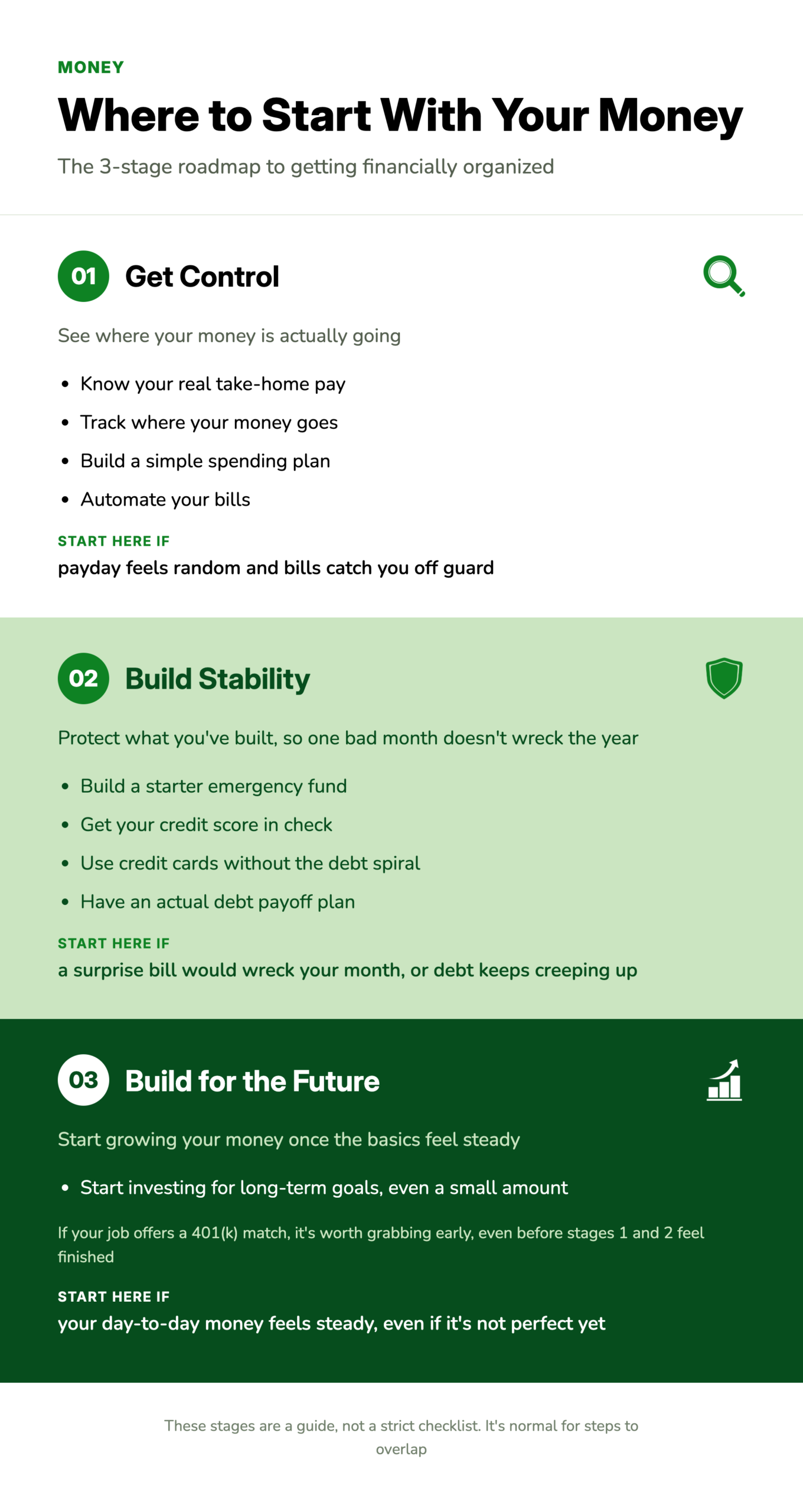
Stage 1: Get Control
These are the skills that tell you what’s actually happening with your money right now. Without them, a budget or savings plan is just a guess.
Skills in this stage:
- Understand your take-home pay (gross vs net)
- Know where your money currently goes
- Use a simple spending plan
- Manage checking and savings accounts
- Automate bills without losing control
Start here if: you’re not sure what actually lands in your account each payday, bills catch you off guard, or you’ve never looked closely at where your money goes.
Stage 2: Build Stability
Once you know your numbers, the next job is making sure one bad month doesn’t turn into a bad year. These skills protect what you’ve built and stop small problems from becoming expensive ones.
Skills in this stage:
- Build a starter emergency fund
- Understand credit reports and credit scores
- Use credit cards without creating expensive debt
- Understand debt and choose a repayment strategy
- Understand taxes and keep financial records organized
- Protect your money from scams and identity theft
Start here if: your day-to-day money is under control, but an unexpected bill would wreck your month, you’re carrying credit card debt, or you don’t know what’s on your credit report.
Stage 3: Build for the Future
This stage is about putting spare capacity toward your future instead of just your present. It usually makes the most sense once Stages 1 and 2 feel steady, but money rarely shows up in that tidy an order. If your job offers a 401(k) match, for example, contributing enough to get it can be worth doing even while you’re still building your emergency fund or paying off debt, since it’s essentially free money. Treat the stages as a general direction, not a strict queue you have to finish in order.
Skills in this stage:
- Start investing for long-term goals
Start here if: your bills and safety net feel steady enough that you have some spare capacity, even if your emergency fund or debt payoff isn’t completely finished yet.
The 12 Money Skills You Actually Need
These are the core financial basics for young adults that reduce uncertainty and decision load. Not an endless finance curriculum. Not a “read 17 books and become a wizard” situation.
Format promise: each skill includes a short explanation plus a “Do it this week” action you can knock out in under 30 minutes.
1) Understand your take-home pay (gross vs net)

Gross pay is what you earned before anything gets taken out. Net pay (your take-home pay) is what actually lands in your account after deductions.
Why your paycheck shrinks:
- Federal and state income taxes (varies by state and your withholding)
- FICA taxes: Social Security + Medicare
- Benefits: health insurance, HSA/FSA, retirement contributions, etc.
Early-adult confusion that is completely normal:
- Hourly vs. salaried: hourly pay changes with hours worked; salary is usually a fixed annual amount split across pay periods.
- Pay periods: weekly, biweekly, semi-monthly, monthly. Your budget cares which one you have.
- Overtime: can make paychecks vary.
- Two paychecks can differ: different hours, bonus, benefit changes, or withholding adjustments.
Your pay stub is the source of truth. If you’re ever unsure about pay, hours, or what your employer is required to provide, the U.S. Department of Labor is a reliable starting point. For more specific inquiries regarding wages and hours, the New York State Department of Labor offers extensive resources.
Do it this week (under 30 min): Pull your most recent pay stub and write down:
(a) gross pay (b) total deductions (c) net pay (d) where it’s deposited.
2) Know where your money currently goes (before you “budget”)
Before you build a plan, take a money snapshot of the last 30 days: spending, bills, transfers. Not to judge yourself. To get reality on the table.
Most overspending isn’t one dramatic purchase. It’s a bunch of tiny leaks: delivery fees, “free trial” subscriptions, convenience store runs, and that one app that charges you $9.99 like it’s paying rent.
Keep it simple:
- Use your checking account transaction history and credit card statements.
- Categorize lightly: housing, food, transport, subscriptions, debt, fun (or whatever 5 buckets make sense). You can refer to this Budgeting 101 guide for more insights on personal budget categories.
Avoid the setup spiral. You do not need a new app, a new spreadsheet, and a new identity as “Budget Person.” You need visibility.
Do it this week (under 30 min): Pull your last month of transactions and total your spending in 5 buckets. Circle the biggest surprise item.
3) Use a simple spending plan (not a perfect one)

A spending plan is a forward-looking outline for the money you’re about to receive. It includes essentials such as rent, utilities, minimum debt payments, groceries, and transport, as well as everyday spending. Additionally, it focuses on one goal you care about right now, like building an emergency buffer, paying off debt, or saving for a moving fund.
Quick options (pick one that fits your brain):
- Bills-first plan: fixed bills + essentials first; what’s left is flexible spending.
- Weekly spending cap: set one weekly number for “everything else” so you don’t accidentally speedrun your paycheck.
- Must-pay / might-pay: must-pay items get funded first; might-pay items only happen if money’s left.
The win: fewer overdrafts, fewer late fees, and less end-of-month panic where you start doing math like a distressed accountant.
Do it this week (under 30 min): List your essentials until your next paycheck (rent, utilities, minimum debt, groceries, transport). Then set one weekly spending limit for everything else.
4) Manage checking and savings accounts (balances, holds, fees)
Your bank app shows numbers. Those numbers are not always telling the full truth.
Key terms:
- Current balance: what’s in the account including pending transactions.
- Available balance: what you can actually spend right now.
- Pending transactions/holds: charges that haven’t fully posted yet (hotels, gas stations, restaurants are common culprits).
Overdraft and NSF fees are how banks profit from chaos:
- Overdraft: the bank covers a transaction even though you don’t have enough, then charges a fee.
- NSF (non-sufficient funds): the bank rejects the transaction and may still charge a fee (varies).
Know your bank’s fee schedule and overdraft settings. Also, keep savings separate on purpose. It’s harder to “accidentally” spend money that’s not sitting in checking next to your taco budget.
FDIC insurance basics matter too: if your bank is FDIC-insured, deposits are protected up to limits, per depositor, per bank, per ownership category.
Do it this week (under 30 min): Turn on low-balance alerts. Then find your bank’s overdraft settings (and the fee page) so you’re not learning them through a $35 surprise.
5) Automate bills without losing control
Autopay is great at one thing: preventing late fees and missed payments. It is also great at a second thing: quietly making a mess if your cash flow is tight or a bill changes.
|
Autopay Pros |
Autopay Cons |
|---|---|
|
Fewer late fees |
Failed payments if your balance is low |
|
Helps protect your credit (for credit-reported bills) |
Overdrafts if timing is off |
|
Less mental load |
“Set and forget” drift, where subscriptions multiply like gremlins |
A solid hybrid:
- Automate fixed bills when your cash flow can handle it (rent, car insurance, minimum card payment).
- Use reminders for variable bills (utilities, credit card statement balance if it changes).
- Keep alerts on so you know what actually happened.
Do it this week (under 30 min): Pick one fixed bill to automate (or set a calendar reminder). Add a payment confirmation alert if your provider or bank offers it.
6) Build a starter emergency fund (small buffer, big impact)
An emergency fund is not just a concept; it’s money set aside for unexpected life events such as car repairs, urgent travel, copays or prescriptions, and replacing a phone that was accidentally damaged. Begin with a realistic buffer rather than aiming for an intimidating amount – starting with around $300 or the cost of a common emergency you might face is a practical and achievable goal.
Where to keep it:
- separate savings
- easy to access
- not invested (because emergencies don’t wait for the market to feel better)
- ideally in an FDIC-insured deposit account
Do it this week (under 30 min): Create a separate savings bucket (or separate savings account) labeled Emergency and move a small first deposit.
7) Understand credit reports and credit scores (what generally affects them)
A credit report is the record of your credit history. A credit score is a number that summarizes that record.
Credit scores are generally affected by several key factors. Payment history is crucial, with on-time payments improving your score and late payments harming it. Credit utilization, or the amount of your available revolving credit you use, also plays a role – lower utilization is typically better. The length of your credit history matters, as older accounts tend to boost your score over time. Having a mix of different types of credit can be beneficial, but you should avoid opening accounts solely to improve this mix. Lastly, multiple new credit inquiries within a short period can temporarily reduce your score.
Get your real credit reports from the official source: AnnualCreditReport.com
Do it this week (under 30 min): Request your credit reports and scan for errors, unfamiliar accounts, or incorrect balances.
8) Use credit cards without creating expensive debt

Using credit is not the same thing as carrying debt. You build credit by paying on time, not by paying interest. Interest is what happens when your balance stops being a tool and starts being a souvenir.
Know these terms:
- Statement balance: what you owe for the last billing cycle.
- Current balance: includes charges since the statement closed.
- Due date: last day to pay at least the minimum on that statement.
- Minimum payment: the smallest amount to stay “current” (and the slowest way to pay).
- APR: interest rate that applies if you carry a balance.
Practical rule: Pay the statement balance in full when possible.
If you can’t: pay more than minimum, and temporarily stop new charges so the balance can actually go down (otherwise it’s like bailing water while the faucet is on).
Do it this week (under 30 min): Find your card’s statement date and due date. Set autopay for at least the minimum, plus a reminder to pay the statement balance manually if you want tighter control.
9) Understand debt and choose a repayment strategy
Some debt is just expensive. High-interest debt (especially credit cards and some personal loans) can trap you because minimum payments stretch repayment out and pile on interest.
Two common payoff methods, both valid:
- Debt avalanche: pay extra toward the highest APR first (mathematically faster/cheaper).
- Debt snowball: pay extra toward the smallest balance first (momentum and motivation).
Pick the one you will actually do consistently. The “best” plan on paper loses to the plan you can keep doing on a random Tuesday when motivation has left the group chat.
Do it this week (under 30 min): List each debt with balance, APR, and minimum payment. Choose avalanche or snowball, then identify your “extra payment target.”
10) Understand taxes and keep financial records organized (US basics)
You don’t need to become a tax pro. You just need the basics so you’re not blindsided.
- W-2: reports wages from an employer (employee income).
- 1099 forms: cover various non-employee income types (gig/contract work, bank interest, etc.).
- Withholding: the amount your employer sends to the government from each paycheck to prepay taxes.
Why organization matters:
- easier filing
- fewer missed credits/deductions
- faster response if something looks wrong
- less “where is that form” chaos in March/April
A simple system:
- one digital folder
- one physical spot for tax mail
- name it by year so Future You doesn’t have to play detective
The IRS is the official source for forms and tax basics. (If a random site is yelling “BIG REFUND HACK,” maybe back away slowly.)
Do it this week (under 30 min): Create a folder called Taxes 2026 (digital). Add your last W-2/1099 and your most recent pay stub.
11) Start investing for long-term goals (retirement accounts, fees, diversification)
.jpg?token=eyJraWQiOiJzdG9yYWdlLXVybC1zaWduaW5nLWtleV8yNzIwYzE2OC0wMDRlLTQzZDItYjk3Yi03ZWQzMDE4NzU5NzciLCJhbGciOiJIUzI1NiJ9.eyJ1cmwiOiJ1c2VyLWdlbmVyYXRlZC1pbWFnZXMvYWM1ZDA2MmYtODM1OS00N2Q5LThlZjgtNTVjZTAxMzNlODI1L3BleGVscy1saXphLXN1bW1lci02MzQ3NzEzICgxKS5qcGciLCJzY29wZSI6ImRvd25sb2FkIiwiaWF0IjoxNzg1NTgyODk0LCJleHAiOjIxMDA5NDI4OTR9.q4Yi9THZiHkiobWl9Cq8EnIn8xKFJCg7Wav9BpD0bUI)
Investing is basically Future You payroll. Not hype. Not memes. Not a personality. Start small and focus on consistency.
If you have a job with a retirement plan, take advantage of the 401(k) match, which is essentially free money since it’s extra compensation when you contribute enough to receive it. Tax-advantaged accounts, such as a 401(k) through work and IRAs that you open yourself, offer tax benefits designed to encourage retirement saving.
Core concepts that matter more than picking “the perfect stock”:
- Diversification. Don’t put all your money into one company or sector. Spreading investments across different industries and asset types reduces risk. If one area dips, others might hold steady or rise, balancing your portfolio. Think of it as not putting all your eggs in one basket.
- Fees/expense ratios. Every investment fund charges fees, usually expressed as an expense ratio—a percentage of your invested assets taken annually. Lower fees mean more of your money stays invested and grows over time. Even small differences compound significantly over years.
Interesting fact: A 1% difference in annual fees can cost you tens of thousands of dollars over decades.
- Low-cost index funds. These funds track a market index (like the S&P 500), giving you broad exposure to many companies at once. Because they’re passively managed, their fees are typically much lower than actively managed funds. This combination of diversification and low cost makes them a popular choice for long-term investors starting out or building steady portfolios.
Do it this week (under 30 min): If you have a workplace plan, check whether there’s a match and what percent you need to contribute to get it.
12) Protect your money from scams and identity theft
Scams are not just for your grandma. Scammers love young adults. You’re job hunting, apartment hunting, and clicking quickly because you have 9,000 things to do.
Common scams hitting young adults:
- fake job listings (especially remote roles)
- “deposit this check and send money back”
- phishing texts from “your bank”
- account takeover attempts (email compromised, then everything else falls)
Practical protections:
- strong passwords (use a password manager)
- multi-factor authentication (MFA), especially on email
- account alerts for transactions
- actually checking statements
- credit freezes (a prevention tool; monitoring is not the same as prevention)
The FTC has clear guidance on identity theft, recovery, and prevention steps like freezes.
Do it this week (under 30 min): Turn on MFA for your email and bank login. Set transaction alerts for card-not-present purchases (online charges).
Want a step-by-step adulting plan without the finance-bro energy?
Want an easy money win without building a whole budget? Use the free Subscription Tracker to find recurring charges, see what they’re costing you, and decide what to keep or cancel.
Conclusion: Financial literacy for young adults is built through reps
You don’t “learn money” once and graduate into a glittering adulthood where nothing breaks and every bill is on time. You build a few systems and repeat them until they’re boring. Boring is good. Boring means your money isn’t actively auditioning to become a problem.
Pick one skill above and do the “this week” action today. And if you want one easy money-admin win, use the free Subscription Tracker.Financial literacy for young adults gets easier when you stop trying to do everything and start doing one small thing consistently.
FAQ: Financial Literacy for Young Adults
What is financial literacy for young adults?
Financial literacy for young adults means understanding the everyday money skills needed to make informed decisions. That includes managing income, planning spending, using bank accounts, understanding credit, handling debt, saving for emergencies, organizing taxes and investing for long-term goals.
What financial skills should every young adult have?
At minimum: understanding take-home pay, tracking spending, making a simple spending plan, managing bank accounts/fees, paying bills on time, building a starter emergency fund, understanding credit, using credit cards safely, having a debt plan, organizing tax documents, starting retirement investing, and scam/identity theft protection.
What financial basics should an 18-year-old know?
An 18-year-old should understand gross and net pay, bank account fees, bill due dates, simple spending plans and the difference between a credit report and a credit score. It is also a good time to begin saving a small amount regularly and learn how credit cards work before applying for one.
What financial skills should you learn in your 20s?
The same basics, with extra emphasis on credit (for renting and borrowing), building an emergency buffer, and starting retirement investing early if you can, even small. These are the “quiet multipliers” for future stability.
How can a beginner improve their financial literacy?
Start with three steps: read a pay stub, do a 30-day money snapshot, and automate a small savings transfer. Then add one new habit per week. Slow and steady beats the “new app, new spreadsheet, new me” cycle.
What is the first money skill a young adult should learn?
Understand your take-home pay. If you don’t know what actually hits your account after taxes and deductions, every other plan is based on the wrong number, and that’s how “I’m fine” becomes “why am I overdrafted?” fast.
Sources
- CFPB: Your Money, Your Goals Toolkit
- IRS: Tax Withholding for Individuals
- FDIC: Overdraft and Account Fees
- CFPB: An Essential Guide to Building an Emergency Fund
- CFPB: What Is a Credit Score?
- AnnualCreditReport.com: Free Credit Reports
- CFPB: What Does Credit Card APR Mean?
- Investor.gov: Asset Allocation and Diversification
- Investor.gov: Understanding Investment Fees
- FTC: Credit Freezes and Fraud Alerts
Important: This article is for general educational purposes and is not personalized financial, investment, tax, legal, or other professional advice. Rules, rates, products, and eligibility can change, and your circumstances may be different. Check current information with the relevant official source and consider qualified professional advice when making decisions specific to your situation.
Get the free subscription audit
One Google Sheet, 70+ services pre-loaded. Find what you’re paying for and forgot about in under 20 minutes. No shame, no spam. Unsubscribe anytime.